Checking Boxes, Cheating Workers: How Social Audit Firms are Complicit in Labor Rights Abuses
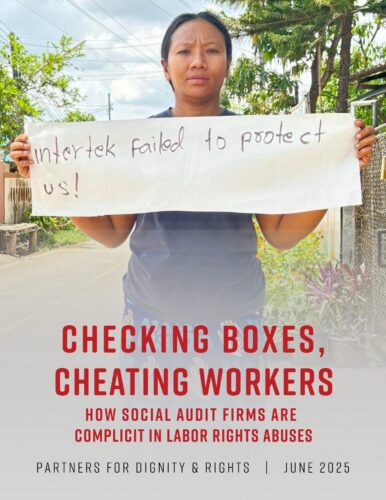
The failures of social auditing are widely documented. Yet over the past few decades, this form of private labor and human rights enforcement has become increasingly commonplace across industries from farms to factories to construction sites. A growing body of evidence shows that social audits are inadequate to detect even the most extreme and systemic abuses of human and labor rights. Yet despite these audit failures, companies still universally rely on social audits to fulfill their human rights obligations.
The report, Checking Boxes, Cheating Workers: How Social Audit Firms are Complicit in Labor Rights Abuses, examines the role of social auditing firms in supply chain regulation through three case studies. These case studies build on existing research to show how social audit firms are not just failing to discover abuses but actively undermining workers’ rights and cosigning corporations’ attempts to skirt responsibility.
Social Auditing Firms Fail to Protect Workers
The case studies in this report all originate in the wage and severance theft crisis that ballooned in the global garment industry during the early period of the COVID-19 pandemic in 2020. Each case study also includes a summary of some key cases of the audit company’s track record across years and industries, revealing themes that span multiple industries and geographies.
Despite these well-recognized risk factors, social audit firms ELEVATE (now LRQA), Impactt Limited, Intertek, and multi-stakeholder initiative Fair Labor Association (FLA) all performed audits or investigations of these factories using methodologies that neglected to address these risks–or in some cases exacerbated them.
Each of these firms market themselves as experts at identifying and addressing human rights risks in corporate supply chains. Yet the case studies examined here demonstrate inadequate due diligence and poor risk assessment, at the very least. In the worst-case scenario, the audit firms appear to act negligently and even to be complicit in covering up abusive practices.
Social Auditing Firms Fail to Respect Human Rights, Provide Access to Remedy
The report examines cases at the Hulu Garment Factory (supplying Amazon and adidas, among others) and the Hong Seng Knitting (supplier to Nike) and V.K. Garment Factory (supplier to Tesco). As of June 2025, none of these workers have received satisfactory remedy.
The UN Guiding Principles on Business and Human Rights establish that businesses have a responsibility to respect human rights and to provide access to remedy when their business practices have caused harm, whether directly or indirectly. Yet despite explicit commitments to these principles, each of the audit firms named in this report currently appears to have done more to delay workers’ access to remedy than to facilitate it.
Each of the cases examined in this report reveals how the social auditing industry continues to use discredited methodology, ignores or fails to adequately assess risk, and undermines workers’ testimony. Taken together, the profusion of audits and audit reports points to another finding: These audits assist companies in risk management not through appropriate due diligence but rather through reputation management.